



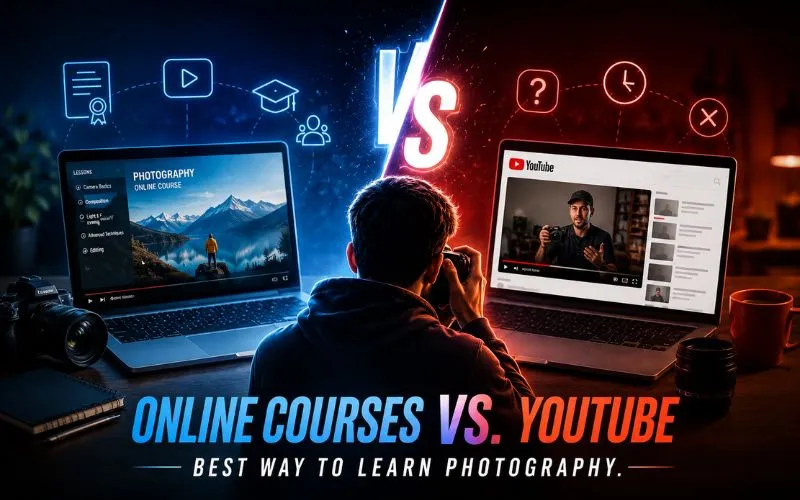
The best way to learn photography isn’t always the one people swear by online.
You buy your first camera, watch a few YouTube videos, learn about aperture and shutter speed, and head out to shoot. A few months later, you’ve watched dozens, maybe even hundreds, of tutorials, but your photos still don’t look the way you imagined.
Sound familiar?
That’s a common experience for beginners. The problem usually isn’t a lack of information; it’s figuring out what to learn first and which advice to follow.
Today, photographers have two popular ways to learn: free YouTube tutorials and structured online photography courses. Both have their advantages, but they serve different purposes.
In this article, we’ll compare online photography courses and YouTube to help you find the best way to learn photography for your goals, budget, and experience level.

Table of contents
Quick Answer
The best way to learn photography is to combine online photography courses with YouTube. Online courses provide structured, step-by-step learning that helps you build strong fundamentals, while YouTube is perfect for quick tips, troubleshooting, and inspiration. If you’re serious about improving your photography skills, a structured course paired with free YouTube tutorials offers the fastest and most effective learning path.
How Most Photographers Learn Today
Nobody’s buying a thick photography textbook anymore. That world is basically gone. If you ask ten photographers today how to learn photography, eight of them will mention YouTube within the first ten seconds. A couple will mention some course they bought. Almost nobody says “I went to a local class.”
What’s changed isn’t really photography itself. A camera still does what a camera has always done. What’s changed is access; you can now sit in your room and learn lighting from someone shooting weddings on the other side of the planet. That’s genuinely useful. It’s also kind of overwhelming because access without direction just means more noise.
So when people ask which method actually works, they’re not really asking “Is online learning legit?” It obviously is at this point. They’re asking which version of online learning gets them results without burning three months chasing random tutorials.
Research in education consistently shows that learners retain information better when lessons build on one another rather than being consumed in a random order. That’s one reason why many photographers eventually move from scattered tutorials to structured learning as they become more serious about improving.
YouTube for Learning Photography: The Pros and Cons
Most beginners start learning photography on YouTube. But is this learning actually a benefit for beginners?
What Makes YouTube Amazing
1. Completely free
This one doesn’t need much explanation. You can binge thousands of hours of content without spending a dollar. If you’re not even sure photography is your thing yet, that’s a low-risk way to test the waters before committing money to anything.
2. Endless variety
Whatever weird niche you’re into insect macro shots, long-exposure waterfalls, shooting the night sky with a basic camera someone’s made a video on it. The range is honestly kind of wild.
3. Learn whenever
No schedule, no deadlines. Watch at 2 am if that’s when your brain works best. Pause, rewind, watch the confusing part five times. Nobody’s checking on you.
4. Good for quick fixes.
Are photos coming out grainy in low light? Type it in, get an answer in two minutes. This is genuinely where YouTube shines: fast, specific problem-solving. Not so much full skill building from the ground up, but quick fixes- yeah, it’s great for that.
Where YouTube Falls Short
Search “how to learn photography,” and you get a few million results. No idea where to even start. Most people just click around for an hour, watch bits of five different videos, and walk away having learned basically nothing.
Too Much Content, Too Little Direction
1. Too Much Content, Too Little Direction
Search “how to learn photography for beginners,” and you’ll get thousands of results. Where do you even begin? Which video should you trust? This overwhelming volume of choice often leads to decision fatigue before you’ve even pressed play.
2. Contradicting Advice
One creator might tell you to always shoot in Manual mode, while another recommends Aperture Priority for beginners. Some say gear doesn’t matter, while others focus heavily on the latest camera. None of them is necessarily wrong, but if you’re just starting out, it’s hard to know which advice actually applies to you.
3. Difficulty Measuring Progress
Watching tutorials is one thing; knowing whether you’re improving is another. After following a few videos and practicing on your own, there’s often no feedback to tell you what you’re doing well or what needs work
4. More Entertainment Than Education
YouTube is designed to keep people watching, so many photography videos focus on grabbing attention with catchy titles and dramatic edits. While they’re often entertaining and inspiring, they don’t always provide a complete or structured learning experience.
Also Check Out: AI Photo Course: Complete Workflow For Photographers
| ✅ Pros of Learning Photography on YouTube | ❌ Cons of Learning Photography on YouTube |
|---|---|
| Completely Free – Thousands of photography tutorials are available at no cost. | No Clear Learning Path – Videos are rarely organized from beginner to advanced. |
| Huge Variety of Topics – Learn everything from camera settings to editing, lighting, and niche genres. | Information Overload – Too many choices can make it difficult to know where to start. |
| Learn Anytime – Watch lessons whenever it fits your schedule. | Quality Varies – Not every creator is an experienced photographer or educator. |
| Great for Quick Solutions – Perfect for learning a specific technique or fixing a problem fast. | Conflicting Advice – Different creators often recommend completely different approaches. |
| Updated Frequently – Creators regularly cover new cameras, software, and photography trends. | Distractions – Ads, recommendations, and unrelated videos can interrupt learning. |
| Watch Before You Buy – Helpful for camera reviews, gear comparisons, and editing software demonstrations. | Limited Feedback – You rarely receive personalized critiques or guidance on your work. |
| Pause & Rewatch – Replay difficult concepts as many times as needed. | No Accountability – Without assignments or deadlines, it’s easy to lose motivation. |
Online Photography Courses: The Pros and Cons
The other route is paid, structured courses usually built by working photographers, broken into modules that actually build on each other.
Why Photography Courses Work
1. Structured Learning
A structured course starts with exposure and camera basics, moves into composition, then lighting, then editing. Each piece builds on the last, which is honestly just how to improve your photography skills in a sane, repeatable order instead of bouncing around.
2. Step-by-Step Progression
Courses are designed with a clear beginning, middle, and end. You’re not jumping between unrelated topics. Instead, each lesson naturally leads into the next, which is one of the most effective ways to improve photography skills steadily over time.
3. Learn From Proven Experts
As photographer Henri Cartier-Bresson famously said, “Your first 10,000 photographs are your worst.” The point isn’t to discourage beginners, it’s to remind us that consistent practice and guided learning matter far more than endlessly consuming tutorials. Wedding photographers who shoot every single weekend. Portrait specialists who’ve worked with hundreds of clients. Their advice comes from doing the thing repeatedly for money, not from wanting a video to perform well.
4. Faster Skill Development
Because each lesson builds on the previous one, structured courses reduce the time spent figuring out what to learn next. Instead of filtering through hundreds of videos, you can focus on practicing, which often leads to faster and more consistent progress.
5. Access to Real-World Workflows
A good course shows you the entire process: setting up the shoot, shooting it, and editing the final image from start to finish. Most YouTube videos show you only one narrow slice of that.
Also Check Out: Post Wedding Photography Workflow
Potential Downsides
1. Cost
This is the most obvious drawback. For someone who isn’t sure they even want to stick with photography, that’s a real barrier.
2. Requires Commitment
Buying a course and never opening it changes nothing. You need to carve out time, go through it, and actually shoot the assignments. A lot of people buy courses with good intentions and then never finish them.
3. Quality Varies Between Courses
Some are rushed, outdated, or taught by someone who knows photography but can’t really teach. This is exactly why the platform matters a trusted site with vetted instructors is a different experience than some random course.
| ✅ Pros of Online Photography Courses | ❌ Cons of Online Photography Courses |
|---|---|
| Structured Learning Path – Lessons follow a step-by-step curriculum that builds your skills progressively. | Usually Paid – Most high-quality courses require a one-time purchase or subscription. |
| Expert-Led Instruction – Learn directly from experienced professional photographers. | Quality Can Vary – Not every course offers the same level of depth or teaching quality. |
| In-Depth Learning – Topics are covered thoroughly instead of being split across multiple videos. | Less Flexible Content – You can’t always jump to niche topics as quickly as on YouTube. |
| Assignments & Practice – Many courses include projects that help reinforce what you’ve learned. | Can Become Outdated – Older courses may not reflect the latest cameras or software features. |
| Lifetime Access – Revisit lessons anytime to refresh your knowledge at your own pace. | Requires Commitment – Getting the most value means completing the lessons consistently. |
| Downloadable Resources – Often includes presets, cheat sheets, RAW files, or project files for hands-on practice. | Limited Course Comparison – Choosing the right course can take time because there are many options. |
| Better Learning Outcomes – A clear roadmap helps you master photography faster with fewer knowledge gaps. | Limited Real-Time Interaction – Many self-paced courses don’t offer live mentoring or instant feedback. |
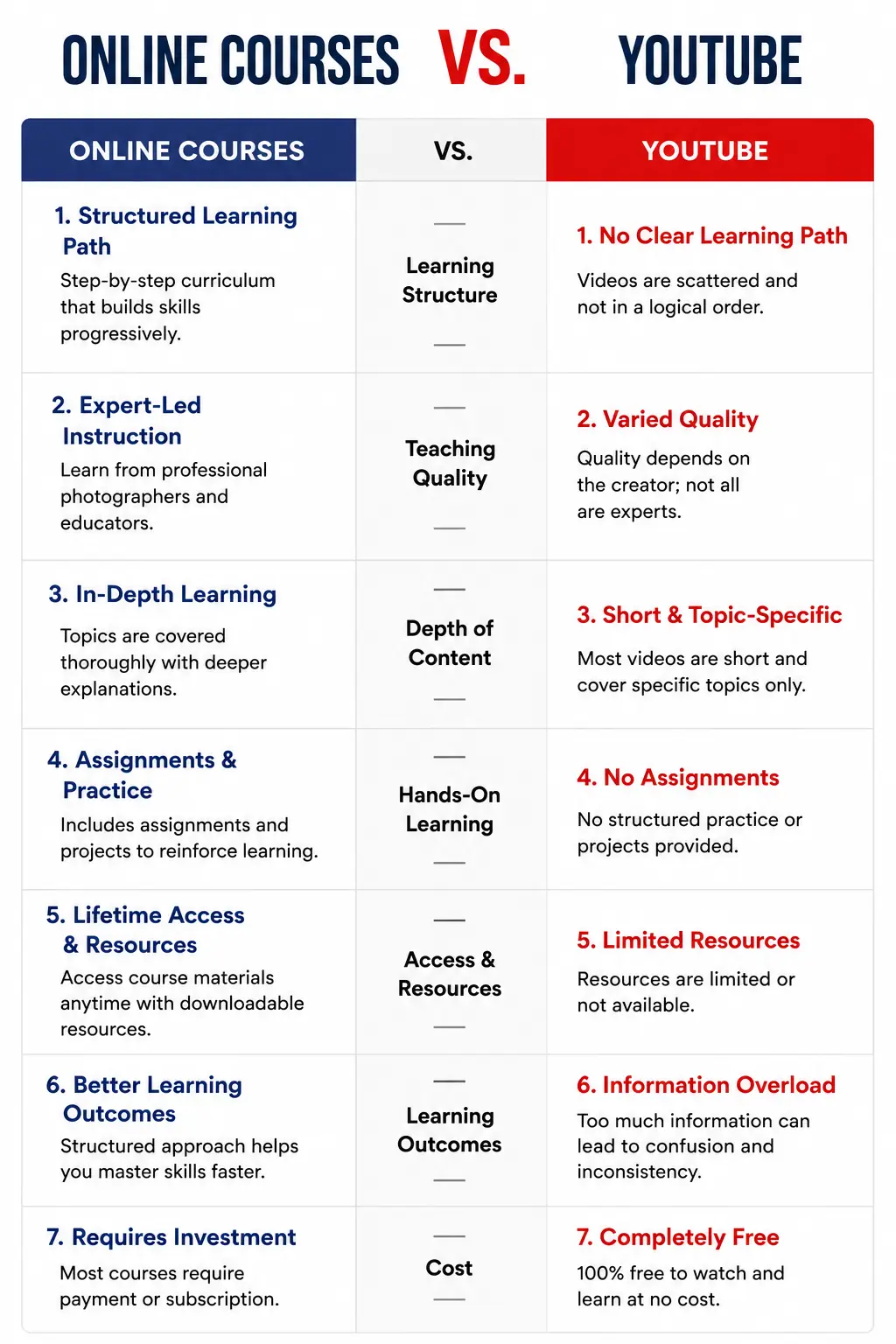
Head-to-Head Comparison
Let’s put both side by side so you can see exactly where each one wins.
Which Method Helps You Improve Faster?
If photography’s just a casual thing for you weekend hobby, no real pressure YouTube’s fine. Watch what looks interesting, go shoot, enjoy it.
But if you’re actually trying to figure out how to improve photography skills in a way that sticks, a structured course tends to win, and it’s not particularly close. Skill building works better with order and repetition and someone checking your work. That’s just what a good course gives you, and it’s exactly what YouTube struggles to provide.
That’s not saying YouTube is useless, plenty of working photographers still pull up a quick tutorial when they need a specific answer. But as your main way of learning from zero, courses tend to get people from confused beginner to actually confident a lot quicker. If you’re specifically looking for the best way to learn photography online. Then the combination real structure plus people who actually know what they’re doing is the difference that matters.
Frequently Asked Questions
Final Thoughts
Most photographers end up using a bit of both anyway. YouTube’s great for the quick stuff, a setting you forgot, a quick fix at 11 pm before a shoot.
But if you’ve been “learning photography” for a year and your photos still look the same, that’s usually not a talent problem. It’s a structural problem. You’ve been collecting random tips instead of building a skill, and those are two very different things.
That’s why the best way to learn photography isn’t choosing between YouTube and online courses, it’s knowing when to use each one. Use YouTube to solve specific problems, discover new ideas, and stay inspired. Use structured courses to build strong fundamentals and develop skills in the right order.
Over time, it’s not the number of tutorials you watch that makes you a better photographer. It’s the consistency of your practice and the quality of your learning path.